A conversation needs more than one translated voice.
In a conversation, the identity of the speaker and the timing of the reply carry meaning. Localising the words is one part of preserving that exchange.
A customer asks a question. A presenter answers. The customer laughs before the next sentence begins.
Translate the recording into a single continuous voice and the words may survive, but the exchange loses its structure. The listener needs to know who is speaking, when they respond and which sounds belong to the scene.
Nativ’s speaker-aware audio workflow brings those decisions into the preparation and review process. It combines timed transcription, speaker information, translated turns, voice assignment and synthesis, with options for retaining background sound where supported.
Begin with the source conversation
Speaker detection is a starting point for review. Listen to the source and check whether each identified turn belongs to the right person. Inspect overlaps, pauses, proper names and short interjections, which can be easy to misattribute.
Keep the relationship between speaker and timing visible as you edit the transcript. A single mistaken speaker boundary can make a convincing synthetic voice say the wrong person’s line.
The current public MCP workflow can return detailed transcript segments and speaker IDs. It also exposes audio capability information, so an automated client can inspect the account’s processing limits before preparing a job. Limits are part of the account and workflow; this guide does not assume that every recording length is accepted.
Translate related turns with shared context
An answer depends on the question that came before it. A pronoun may refer to an earlier speaker. A joke can span two turns. Translating each fragment in isolation gives the language operation less information than the listener has.
Nativ exposes dialogue translation alongside batch text translation, allowing related speaker turns to be considered with shared context. Review the resulting exchange as a conversation. Make sure the target text preserves who is making a claim, asking a question or giving an instruction.
Duration adds another constraint. A clear sentence may need different phrasing to fit the available interval. Timing controls help prepare a result, but they do not decide whether a line sounds rushed, hesitant or unnaturally compressed.
Review one short exchange
- Choose a recording your team can use. Start with a short, clear exchange between two speakers. Retain the original for comparison.
- Prepare and inspect the transcript. Check words, speaker assignments and timed turns before generating a target-language version.
- Choose the target language and brief. Include the audience, relationship between speakers and any terminology that needs to remain consistent.
- Assign the voices deliberately. Use available preset or saved voices as appropriate. For an original-speaker voice, follow the required ownership, permission and consent flow rather than assuming the source recording grants those rights.
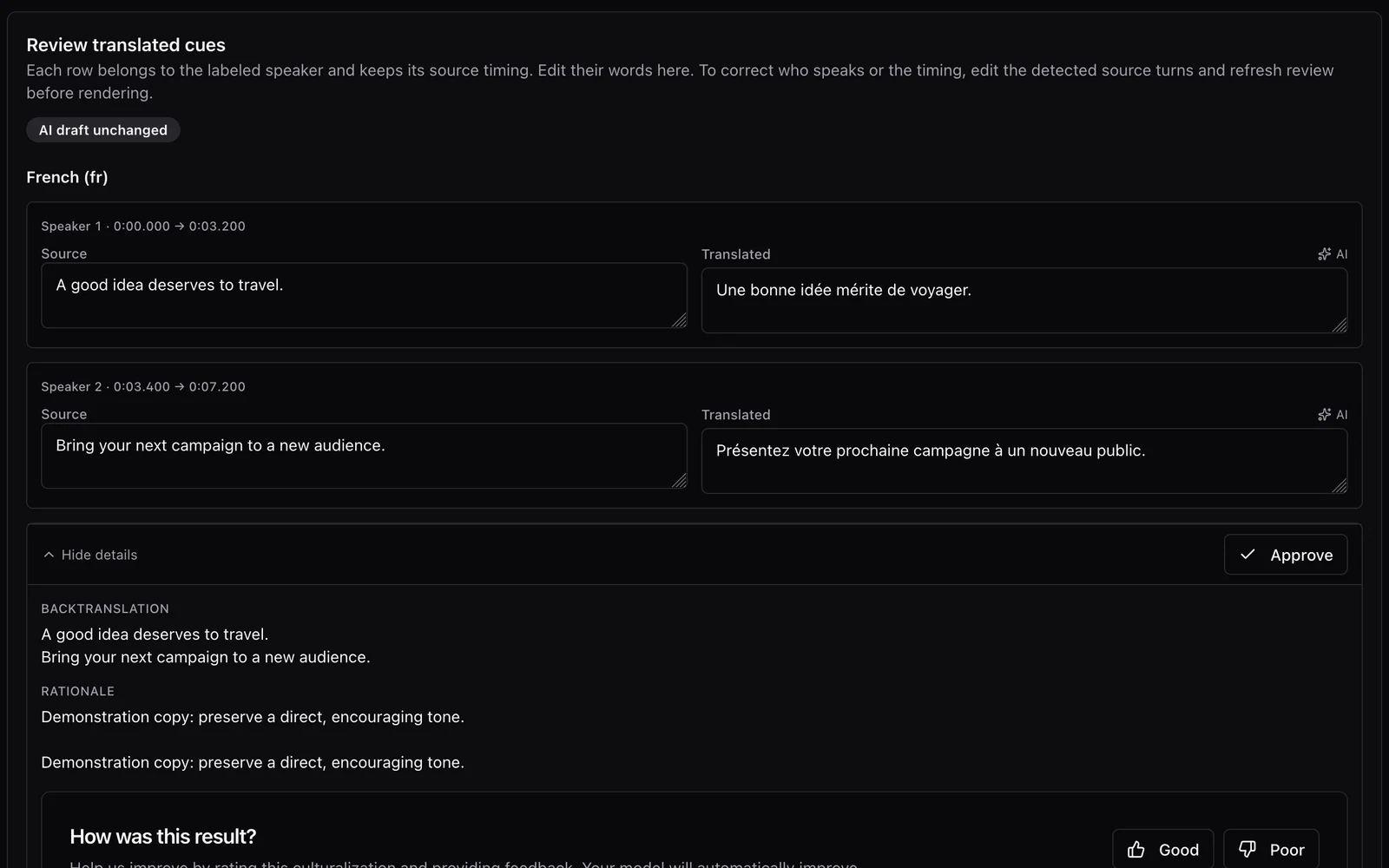
- Review the translated turns and timing. Correct the script before rendering, and resolve the timing or missing-text warnings shown by the review surface.
- Generate and listen to the complete result. Check speaker continuity, pronunciation, pauses, background sound and the connection between speech and picture. Revisit the script or voice choice where necessary.
For an MCP-driven workflow, the public tool sequence includes detailed transcription, voice discovery, dialogue translation and advanced synthesis with speaker-to-voice assignments. Generated media still needs a client or editor that can open and play the returned artifact.
Listen to the mix, not just the sentences
A voice can sound good alone and compete with the music in the finished film. A pause can fit the numeric duration and still interrupt the rhythm of the exchange. Listen on the kinds of devices the audience is likely to use.
Where the workflow supports background preservation, compare it with the source and check that speech and environmental sound remain understandable together. If a processing limit clipped the source, confirm which portion was processed before describing the result as a complete localisation.
Captions need their own final check. Use the subtitle review and export workflow to make sure the written version matches the delivery you approved.
The aim is an exchange the listener can follow: recognisable speakers, coherent replies and timing that carries the conversation into another language.
Product references

The last step is the subtitle file you can actually use.
Review translated subtitle cues, keep timing connected to the words, and export a regenerated SRT or ITT file after edits in Nativ.

A film is more than its soundtrack.
Inside the Nativ Video workflow: transcription, script review, voices, timing and the creative layers that make a film feel local.